The international break gives FPL managers a rare chance to react to injuries and team news before the festive fixture crunch. Here's where the Wildcard makes sense and where it doesn't.
Plenty of managers have sat on their Wildcard through the early weeks, waiting for a moment that justifies it. This international break might be that moment. With two weeks of unlimited transfers and no matches to play, the Wildcard's main strength is timing: you can react to fresh team news without giving up points on the pitch.
The case for pulling the trigger now is stronger than usual, but it isn't one-sided. Here's how I'd weigh it, followed by a Gameweek 11 Wildcard draft for managers who want a squad built around the next few weeks.
Why the break is a good time to act
Reacting to injuries before they cost you
Injuries are the obvious argument. An active Wildcard lets you drop players whose fitness has become a worry, and we've already seen a fair few of those. Johan Manzambi (£6.2m), Virgil van Dijk (£6.4m), Ezri Konsa (£4.8m) and Marc Guehi (£6.0m) are all names that could push managers toward a reset. Team news on Joao Pedro (£7.6m) is another reason to keep your options open.
The trick with injury-driven moves is that they're only useful if you act before the deadline pressure builds. A Wildcard played during the break gives you time to read press conferences and squad updates properly, rather than making a rushed call on deadline morning.
Building team value while transfers are quiet
Transfer activity usually dips mid-break, but prices still move. They tend to pick up again in the days before Gameweek 11, which means there's value to be found if you're selective. Unlimited transfers also give you room to upgrade a player whose price has dropped, or to bring in someone who's about to rise.
A fuller data set makes sweeping changes safer
Offloading underperformers is always a reasonable reason to Wildcard, but it's easier to justify with ten Gameweeks of data behind you. Some players look bankable on early returns and then fade. Manchester United's ranks have produced a few examples of that pattern, and Cole Palmer (£9.8m) is a reminder that even a premium asset can lose form. A larger sample makes it easier to tell a real trend from a hot start.
With suspensions looming for some popular picks and fixture congestion coming in the winter, a Wildcard now also lets you build depth. Reliable back-up options can save you from a double headache later.
Targeting the fixture swings
This is where the Wildcard earns its keep. Liverpool, Brighton and Hove Albion, Bournemouth and Aston Villa all have fixture runs that look appealing for the coming weeks, and the in-form players from many of those sides are the same names the draft below leans on.

The downsides worth weighing
Gameweek 12 is the problem week
Wildcards should serve a medium-to-long-term plan, and that's where Gameweek 12 gets awkward. Arsenal and Manchester City, two teams many Wildcarders will want to back in some form, meet that week. There's also a Merseyside derby and a Nottingham Forest against Chelsea fixture that's hard to call either way. If your squad is built around the short term, that week could sting.
If you still have your Free Hit available, that concern mostly disappears. Managers without it should look at the fixture run more carefully before committing.
Managerial changes add uncertainty
The break has already brought two sackings, with Michael Carrick and Pierre Sage both out of their jobs. Mauricio Pochettino is expected to take over from Carrick at Manchester United. Could that produce a new-manager bounce ahead of what looks like a kind run of fixtures from Gameweek 12? Possibly. But a bounce is a hope, not a guarantee, and it's hard to price in before a new coach has coached a match.

Waiting a week or two would let you see how the situations at both Manchester United and Crystal Palace develop. That's a fair argument for patience, especially if your team is in decent shape.
The emergency argument
The classic counterpoint still applies. Keeping the Wildcard for emergencies makes sense, because the winter months tend to bring more injuries, suspensions and unexpected rotation. If you can get by with minor tweaks now, saving the chip for that stretch could be the smarter play.
Gameweek 11 Wildcard draft

This draft works well if your team value can absorb it. If funds are tight, there are cheaper routes through each position, and I've flagged them below.
Goalkeepers
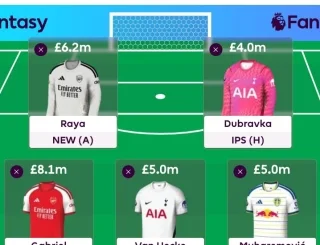
In goal, David Raya (£6.2m) is a near-certain starter for Arsenal, and that matters during the festive period when midweek fixtures make rotation more likely. A bargain back-up completes the pairing.
If you want to lower the goalkeeping spend, a rotating pair of James Trafford (£5.0m) and Antonin Kinsky (£4.4m) is the cheaper route.
Defenders
The backline is built as a big five, anchored by Gabriel Magalhaes (£8.1m). He's the most secure starter in Mikel Arteta's defence, has hit the defensive contribution (DefCon) threshold in three of his last four outings and has scored recently. That's a rare combination of floor and upside at centre-back.
Tarik Muharemovic (£5.1m) and Jan Paul van Hecke (£5.1m) bring DefCon points and attacking threat. Between them, they've produced two goals and two assists across the last seven Gameweeks. Rotating between the two also works well, which is why they're both in the mix.
Antonio Silva (£5.1m) has hit the DefCon threshold in seven of his 10 matches so far, and Luka Vuskovic (£5.0m) offers the same mix of defensive returns and attacking threat. Those two complete the back line.
Midfielders
Spending heavily in defence means finding savings elsewhere, and midfield is where the costlier options are either injured or out of form. Going a little lighter here makes sense.
Chelsea's Morgan Rogers (£8.2m) is the priciest of the group, with five goals and an assist from 10 matches. Marcus Tavernier (£6.7m) has five goals of his own and has become more attractive as Bournemouth's form has improved. Pascal Gross (£6.3m) has blanked in successive matches only once this season, against Liverpool and Manchester City.
One caveat: Gross, Tavernier and Antonio Silva each have four yellow cards this season. Another booking before the end of Gameweek 19 would bring a one-match ban, so keep an eye on discipline if you go this route.
The engine room is completed by Coventry City's penalty-taking bargain Jack Rudoni (£4.9m) and Aston Villa skipper John McGinn (£5.4m). McGinn has six attacking returns in his last six starts. He might not always take penalties when Emiliano Buendia (£5.9m) or Ross Barkley (£5.0m) are on the pitch, but his minutes are far more secure than theirs.
Forwards
Up front, the in-form Nicolas Jackson (£7.1m) and Alexander Isak (£9.3m) join Erling Haaland (£15.8m). Jackson has scored six goals and added an assist in his last six league appearances. His next five fixtures against Sunderland, Ipswich Town, Crystal Palace and Coventry City look inviting.
Isak is the most expensive piece of the puzzle that many managers will find hard to afford. But Liverpool's line leader trails only Haaland for league goals this season, so he's a strong reason to spend. If you need to save funds, the forward line is the easiest place to do it. Thierno Barry (£5.7m) and Evanilson (£6.5m) are both in similarly good form at much lower prices.
The verdict
My read: the international break is a sensible time to Wildcard, especially if your team has injury problems or you're still carrying players who have stalled. The upside of reacting to team news and targeting the fixture swings is real. But the Gameweek 12 fixture cluster and the managerial changes at Manchester United are good reasons to think about the next two or three Gameweeks, not just the next one. If you still have your Free Hit, you can be more aggressive. If you don't, the emergency argument is worth taking seriously.
Whatever you decide, check the team news again before the deadline. The break has already shifted the picture twice, and it could shift again.
Discussion
Sign in to join the discussion.